
Garages, decks and shop floors in Broward
Epoxy Flooring in Fort Lauderdale, FL
Coatings chosen for a wet, sunny, salty city: moisture tested first, priced in writing, put down when the air is right.
- Free estimates at your home, where we measure and inspect the concrete in person
- Moisture testing on the concrete before any coating is chosen
- Every quote is written and itemizes the surface prep and each coat before giving the total price
Concrete Coatings Built Around Fort Lauderdale Weather
Epoxy flooring in Fort Lauderdale has a harder job than it does in most of the country, and the reason is water. The city is often called the Venice of America, with about 165 miles of waterways inside its limits, and much of it sits around 7 feet above sea level. That means the groundwater under a garage slab is rarely far away. Add a wet season that runs from May through October and roughly 61 inches of rain a year at the airport, and you have concrete that is damp from below for months at a time. A coating that ignores that moisture lifts, bubbles or peels. One that is planned around it can give you a clean, sealed, easy-to-wash floor that holds up.
What we coat
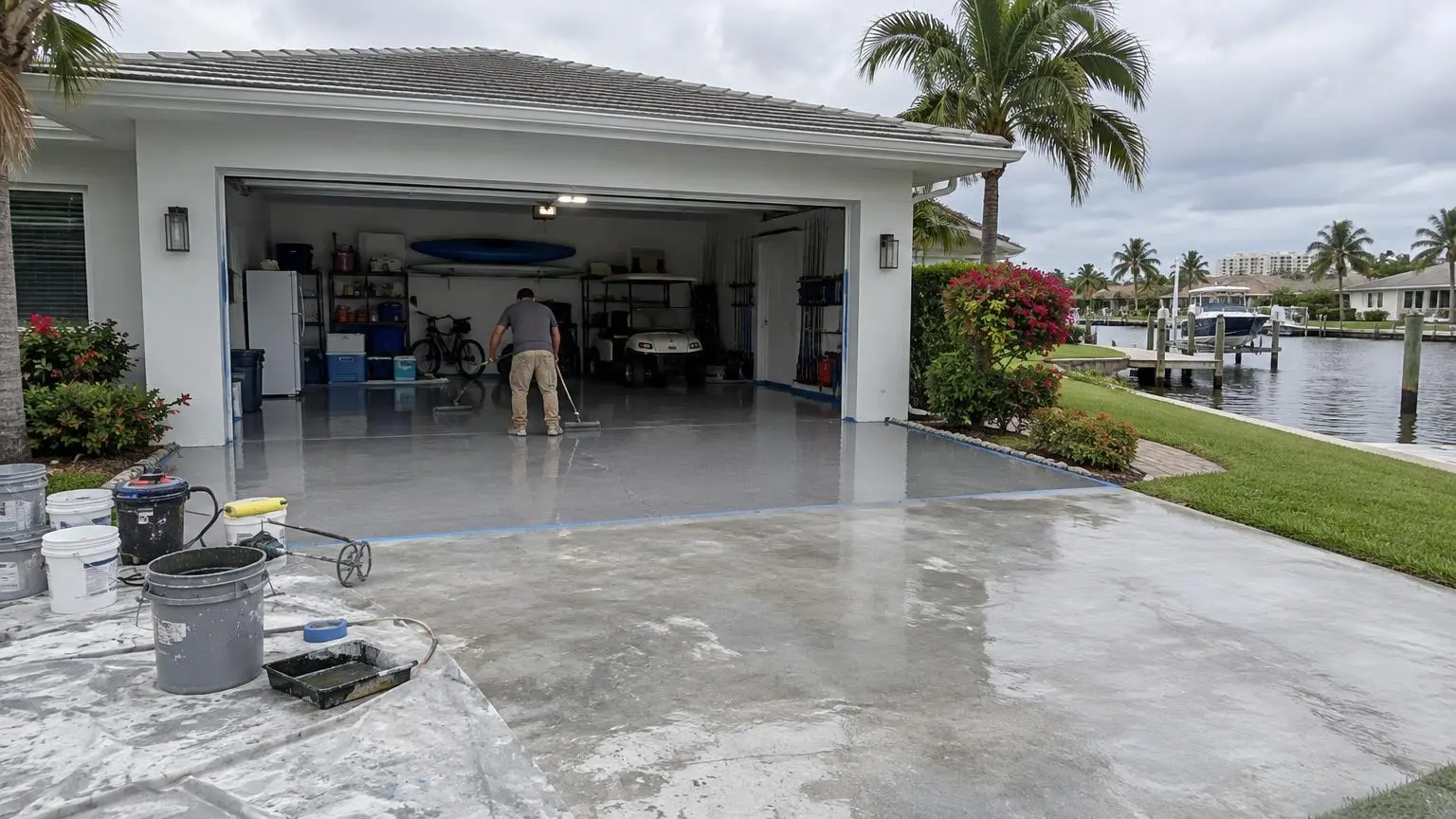
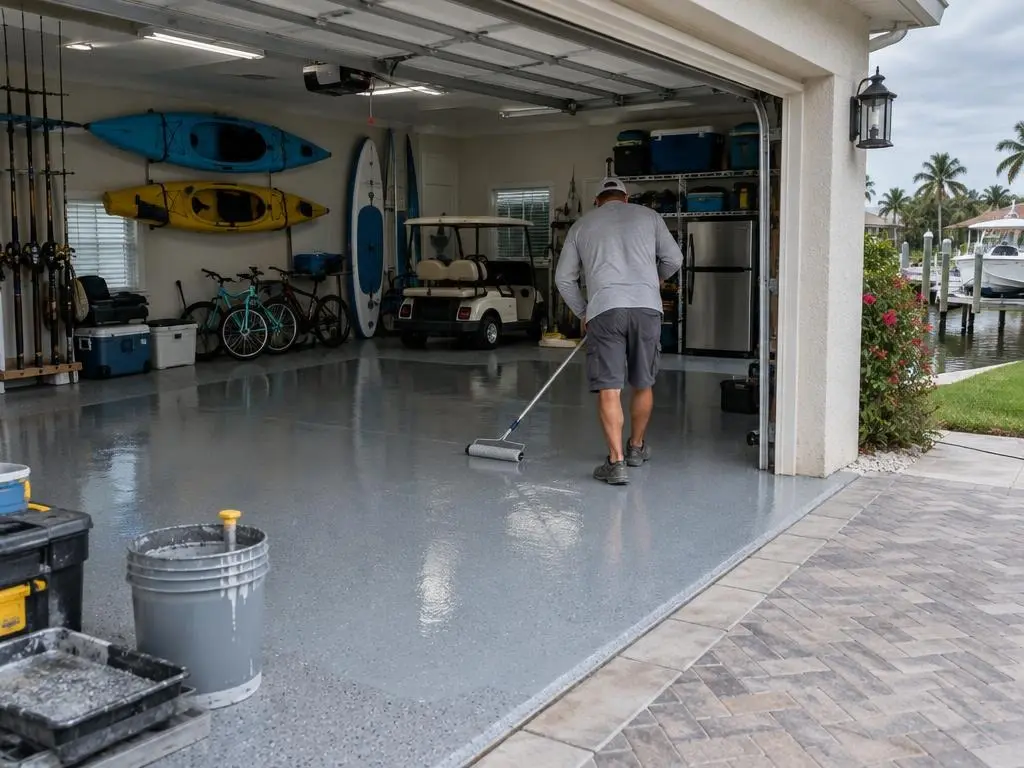
Most of our calls are for garages. A garage in this city seldom holds only a car. Inside you will find fishing rods, coolers, kayaks, paddleboards, bikes, a golf cart, a beer fridge and often the washer and dryer. Fort Lauderdale is home port to around 42,000 boats, so we also see plenty of garages where tackle, outboard parts and salty gear drip onto the floor. Beyond garages, we coat lanais, covered patios, pool decks, laundry rooms, home gyms, workshops, warehouse bays, retail floors and service areas. Each of those spaces gets a system matched to what happens on it, and the six service pages below explain the options in detail. Get a free estimate
Why the slab test comes first
Moisture vapor moves up through concrete all the time. On a dry inland slab that is a minor issue. Here, with a high water table, irrigation running next to the foundation and summer storms soaking the ground, it can be the whole story. Before we recommend any epoxy floor coating, we test the slab. From that reading we learn whether an ordinary primer is enough, whether the floor needs a moisture-tolerant primer, or whether the concrete is too wet for any coating until the source is dealt with. We would rather tell you that on day one than have the floor fail in its first wet season.
Sun, salt and heat
Fort Lauderdale averages around 3,000 hours of sunshine a year. Sunlight is hard on plain epoxy. In HomeGuide's comparison chart, epoxy scores poor to fair for UV and polyaspartic scores excellent, which is why standard epoxy left in the sun tends to yellow and chalk. Any floor the sun reaches through an open door, and every outdoor surface we coat, gets a UV-stable topcoat or a full polyaspartic system. Salt air near the beach and the Intracoastal, sand tracked in from A1A, and hot tires after a summer drive are the other forces we plan for. A properly ground and coated slab keeps salt and sand on top where a hose and squeegee can clear them, instead of letting them work into bare concrete.
Choosing between systems
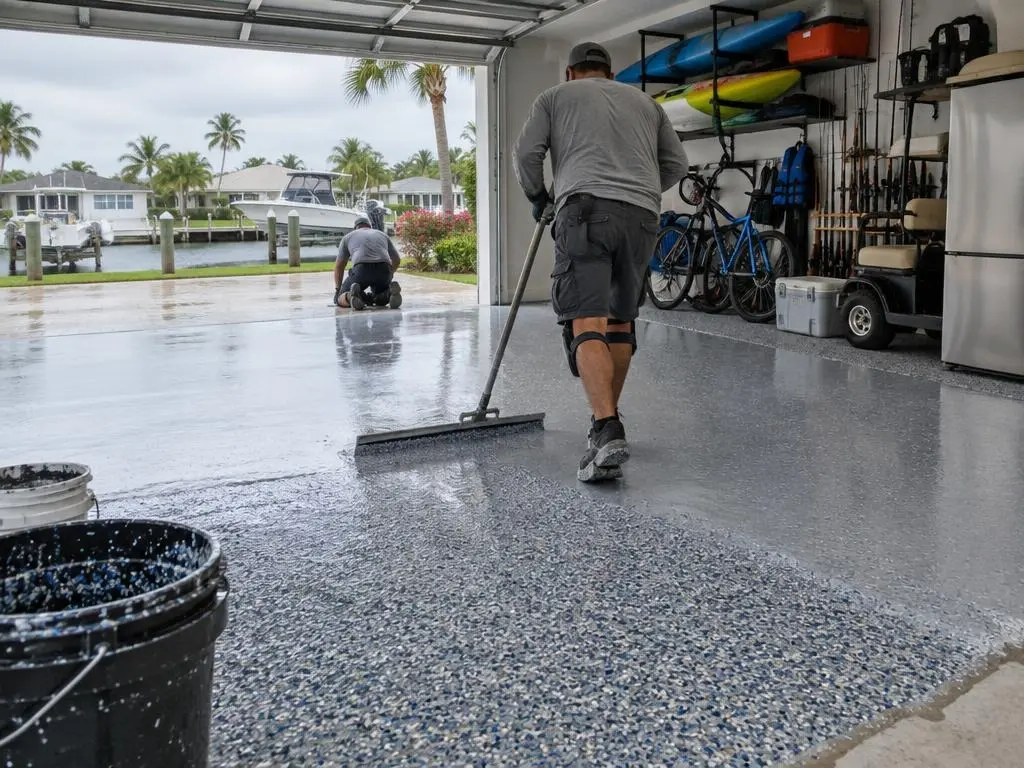
People often ask us which coating is right. There is no single answer, but the trade-offs are clear. A solid-color or flake epoxy base with a polyaspartic topcoat is the workhorse for garages. A full polyaspartic system cures faster and handles sun better, so it suits busy households and outdoor slabs. HomeGuide notes that polyaspartic reaches full cure in one to two days, compared with as long as a week for epoxy. Flake broadcast floors hide dirt and add grip. Metallic epoxy is a poured, glossy finish for indoor rooms where appearance matters most. Commercial epoxy flooring uses thicker builds for forklifts, carts and chemicals. Pool decks and patios need texture, UV resistance and a surface that does not get as hot underfoot.
Epoxy flooring cost in Fort Lauderdale
National cost guides give a useful starting range. HomeGuide's epoxy guide lists installed work at $4 to $10 per square foot and a two-car bay at $1,600 to $5,800, and its polyaspartic guide shows $5 to $12 per square foot. Prep is the biggest swing factor here: grinding off old paint or a peeling store-kit coating, repairing cracks and spalled joints, a moisture-mitigating primer, and the finish you choose. Because those details vary so much from one slab to the next, we measure and test before giving a number. The written estimate we hand you is the price.
Questions for epoxy flooring contractors
Whoever you hire, a few questions separate careful epoxy floor installers from the rest. Ask whether they test for moisture, and how. Ask whether they grind the floor or only acid etch it. Ask what topcoat they use on floors that see sun, and how they handle cracks and control joints. Ask how many hours before foot traffic and how many days before a car can roll onto it. Ask to see each coat and the prep listed on the quote rather than one lump sum. Good epoxy flooring companies answer those questions without hesitation, and we put the answers in writing.
Storms, flooding and timing
Hurricane season and the wet season overlap here, and NWS Miami lists April 12, 2023 as the wettest day on record for the Fort Lauderdale area, a reminder that a big rain can arrive outside the summer months too. We schedule coats around the forecast and the dew point, not just the calendar. Winter and spring, with drier air, are the easiest months for outdoor work, but indoor and garage floors can be done year round when we watch the readings. If your garage takes on water during storms or king tides, a coating will make it far easier to clean out afterward, but it will not stop the water. We will be straight with you about that difference.
Getting started
Call (754) 240-3607 or send the form with a few details about the floor. We'll pick a visit day to measure, test the slab and talk through the options, then follow up with a written quote. The estimate is free, and you are under no pressure to book. If the slab needs work a coating cannot fix, you will hear that from us first, along with what we would do once it is sorted.
Fort Lauderdale and the Towns Next Door
Our work centers on Fort Lauderdale and its neighborhoods, including Victoria Park, Rio Vista, Harbor Beach, Coral Ridge, Flagler Village, Sailboat Bend, Colee Hammock and the Las Olas Isles. We also cover Wilton Manors, Oakland Park, Dania Beach, Lauderdale-by-the-Sea, Hillsboro Beach, Sea Ranch Lakes, Lazy Lake, Broadview Park, Pembroke Park, West Park, Roosevelt Gardens, Washington Park and Franklin Park. Floors differ a lot across that map. Canal and island homes deal with salt air, low ground and boats in the garage. Historic districts have older, often patched slabs. Barrier island condos and gated villages tend to need association approval, and newer townhomes near downtown usually have smaller garages with sound concrete. The town pages go into the local details, one community at a time.
- Epoxy Flooring in Fort Lauderdale, FL
- Epoxy Flooring in Victoria Park, FL
- Epoxy Flooring in Rio Vista, FL
- Epoxy Flooring in Harbor Beach, FL
- Epoxy Flooring in Coral Ridge, FL
- Epoxy Flooring in Flagler Village, FL
- Epoxy Flooring in Sailboat Bend, FL
- Epoxy Flooring in Colee Hammock, FL
- Epoxy Flooring in Las Olas Isles, FL
- Epoxy Flooring in Lauderdale-by-the-Sea, FL
- Epoxy Flooring in Hillsboro Beach, FL
- Epoxy Flooring in Sea Ranch Lakes, FL
- Epoxy Flooring in Lazy Lake, FL
- Epoxy Flooring in Wilton Manors, FL
- Epoxy Flooring in Oakland Park, FL
- Epoxy Flooring in Dania Beach, FL
- Epoxy Flooring in Broadview Park, FL
- Epoxy Flooring in Pembroke Park, FL
- Epoxy Flooring in West Park, FL
- Epoxy Flooring in Roosevelt Gardens, FL
- Epoxy Flooring in Washington Park, FL
- Epoxy Flooring in Franklin Park, FL
Common Questions
What is the downside of epoxy flooring?
Plain epoxy yellows and chalks in sunlight, it can be slippery when wet without added texture, and it takes longer to cure than polyaspartic. HomeGuide notes you may need to avoid driving on an epoxy floor for two to seven days. It also fails when put on a damp or poorly prepared slab, which is why we grind and moisture test first and use a UV-stable topcoat where the sun reaches.
What would 1,000 square feet of epoxy flooring cost?
Coating guides quote by area, so start with the per-foot rate. For installed epoxy, HomeGuide shows $4 to $10 a square foot, and This Old House shows $3 to $12 for pro work; multiply by 1,000 for a rough band. Where your floor lands in that range depends on prep, repairs and finish. After we measure and test, the written estimate we give you is the price.
What is the price of epoxy on a 20x20 floor?
Twenty feet by twenty gives 400 square feet, close to a standard two-car garage. For a two-car size, HomeGuide's guides show $1,600 to $5,800 in epoxy and $2,000 to $6,900 in polyaspartic. Where yours lands depends on old coatings, crack work and flake coverage, which we check in person.
Will an epoxy floor hold up to Fort Lauderdale humidity?
Yes, when the slab is tested and the coats go down in the right conditions. Humidity mostly causes trouble during installation, when moisture condenses on a cool slab or rises through it. Before each coat we read the dew point and slab moisture and move to a moisture-tolerant primer whenever the readings run high.
Is epoxy or polyaspartic better for a garage that faces the sun?
For a garage that sits with the door open in strong light, polyaspartic is the safer choice, used for the whole build or just as the top layer above epoxy. In HomeGuide's chart, polyaspartic is excellent on UV and epoxy is poor to fair. The faster cure is a bonus: your car is back inside sooner.
Can you coat a condo or townhome garage?
Yes. Many condo and HOA communities in Broward ask for approval before work, set work hours, or limit where equipment can go. Tell us about any rules when you call, and we can provide product information for the board and schedule the job inside the allowed hours.
How long before I can use the floor again?
It depends on the system and the weather. According to Bob Vila, polyaspartic floors can handle walking in about 3 to 4 hours and cars after about 24 hours, while epoxy usually needs about 12 hours for walking and around three days before parking. We give you the exact times for your floor on the day we finish.
Do I need to empty the garage first?
Yes, the floor has to be clear from wall to wall so we can grind and coat it evenly. Most people move things to the driveway, a side yard or a storage pod for the few days the job takes. Shelving that is bolted to the wall can usually stay if the floor beneath it is clear.
Why Homeowners Call Fort Lauderdale Epoxy Flooring
Slab moisture checked before we quote
With groundwater only a few feet down, we test the concrete first and choose a primer to match the reading, or tell you the slab is not ready.
Sun-rated topcoats where light reaches
Where sun reaches the floor, as on lanais, pool decks and garages with the door up, we finish with polyaspartic or another UV-stable coat, since plain epoxy yellows in sunlight.
Coats timed to the dew point
Before each coat we log the air temperature, humidity, dew point and the slab's own temperature, and we hold off when conditions would weaken the bond.
Every line of the price in writing
The quote names the prep, the system, each coat and the total. If anything shifts mid-job, you sign off on the change in writing first.
Our Epoxy Flooring Services
Six concrete coating systems for the floors people in and around Fort Lauderdale actually use: busy garages, sunny decks, showpiece rooms and hard-working commercial slabs.
Epoxy Garage Flooring
A ground, sealed garage floor with a sun-rated topcoat that sheds salt, sand, oil and summer storm water.
Learn more →Flake Epoxy Floors
Broadcast vinyl chip floors that disguise sand and dust, improve grip and come in blends from subtle to bold.
Learn more →Polyaspartic Floor Systems
Quick-return coatings that shrug off hard sun, with most floors back in use the next day.
Learn more →Metallic Epoxy Flooring
Poured, high-gloss floors with swirling pearl and metal tones for living spaces, bars, studios and showpiece garages.
Learn more →Commercial Epoxy Floors
Heavier-build, chemical-resistant coatings for warehouses, marine shops, kitchens, retail floors and service bays, timed to fit your business hours.
Learn more →Pool Deck & Patio Coatings
Sun-proof, textured finishes for decks, patios and lanais, chosen for bare feet, pool splash and summer heat.
Learn more →Book a Free Floor Estimate in Fort Lauderdale
After measuring and moisture-testing your slab, we put the price in writing. Call (754) 240-3607 or use the form.